Right to Manage (RTM) Explained: A Plain-English Guide for Leaseholders
If you own a leasehold flat and you are sick of rising service charges, repairs that never get done and a managing agent who won't answer your emails, there is something you can do about it. It's called the Right to Manage, and most leaseholders have never heard of it.
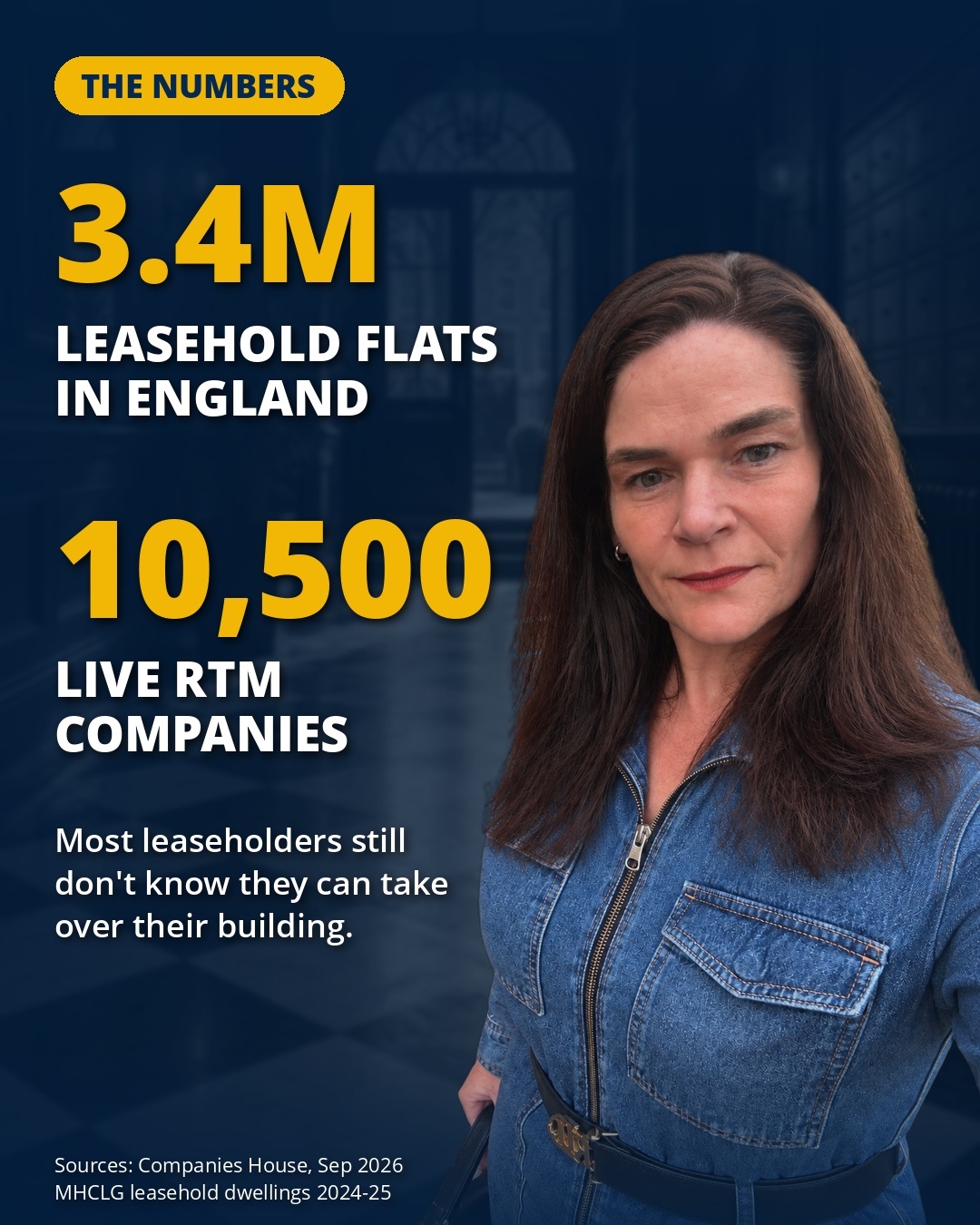
There are around 3.4 million leasehold flats in England. Yet only around 10,500 live RTM companies are registered at Companies House. That is a tiny number when you think about how many people are unhappy with how their building is run.
This guide explains what the Right to Manage is, whether your block qualifies, how the process works and what to watch out for. We are leaseholders ourselves and we have taken over the management of blocks from freeholders and their agents, so this is written from experience, not theory.
What is the Right to Manage?
The Right to Manage (RTM) was introduced by the Commonhold and Leasehold Reform Act 2002. It lets the leaseholders of a block of flats take over the management of their building from the freeholder, through a company they set up and control.
Three things make it different from anything else available to leaseholders:
No fault. You do not have to prove the freeholder or managing agent has done anything wrong. You don't need a list of complaints.
No court. If the paperwork is done properly and the freeholder does not object, the right passes to you automatically on a fixed date.
No buying the freehold. You do not pay the freeholder anything for the right. The freeholder still owns the building; you just take over running it.
What does the RTM company actually take over?
Once the right is acquired, the RTM company takes over the management functions in the leases. In practice that means:
- setting the budget and collecting the service charge
- arranging repairs, maintenance and cleaning of the common parts
- choosing (or sacking) the managing agent, or running the block yourselves
- handling most approvals under the leases, such as consent for alterations (with notice to the freeholder)
- managing the building insurance, where the lease makes the landlord responsible for it
The freeholder keeps the freehold, the ground rent and certain rights, such as dealing with forfeiture. The freeholder can also become a member of the RTM company if they want to.
Does my building qualify?
Your block will usually qualify if:
- it is a self-contained building, or a self-contained part of a building (such as one block on a larger estate)
- it contains at least two flats
- at least two-thirds of the flats are held on long leases (originally granted for more than 21 years)
- the commercial part (shops, offices) is not too big a share of the internal floor area
There are some exceptions. RTM is not available where the freeholder is a local authority, or in some small converted buildings where the freeholder lives in one of the flats. If you are not sure, it is worth getting it checked before you start, because a building that doesn't qualify means the whole claim fails.
How many leaseholders need to take part?
The qualifying leaseholders of at least half the flats in the building must be members of the RTM company when the claim is made. In a block of 20 flats, that means 10. In a building with only two flats, both must join.
You do not need everyone. Leaseholders who don't join still benefit, and they can join later.
The Right to Manage process, step by step
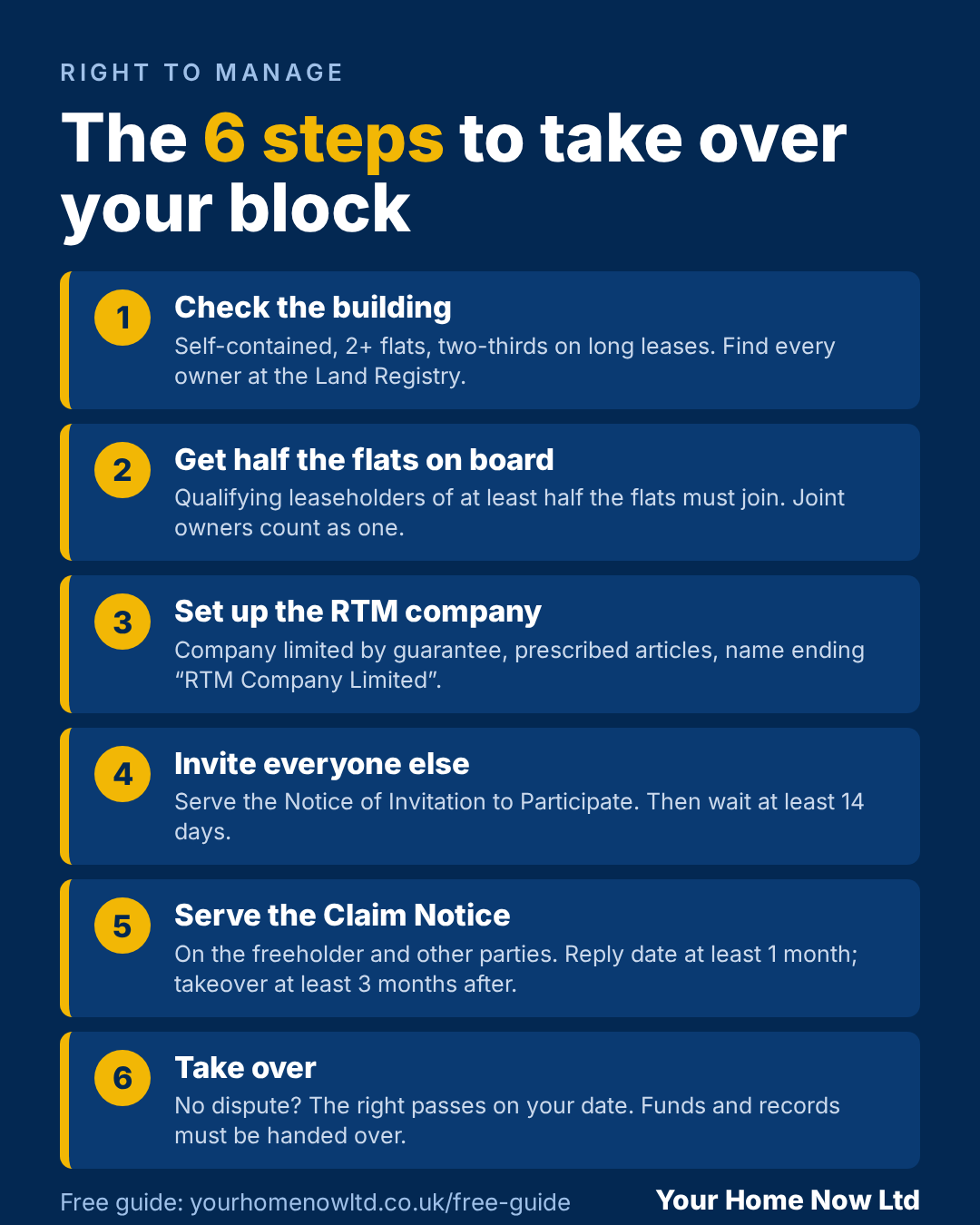
1. Check the building and get your neighbours together. Confirm the block qualifies and find out who owns each flat. The Land Registry will tell you. Then talk to your neighbours. This is usually the hardest part.
2. Set up the RTM company. It is a company limited by guarantee, registered at Companies House, and it must use the articles of association set out in the regulations. Its name must end with "RTM Company Limited" or "RTM Limited".
3. Serve a Notice of Invitation to Participate. Every qualifying leaseholder who hasn't already joined must be formally invited. You must wait at least 14 days after this notice before the next step.
4. Serve the Claim Notice. This goes to the freeholder, any other party to the leases (such as a management company) and any manager appointed by the tribunal. It sets a deadline for the freeholder to reply (at least one month) and the date the RTM company will take over (at least three months after that deadline).
5. Wait for the counter-notice. The freeholder can either accept the claim or dispute it. If they dispute it, the RTM company can apply to the First-tier Tribunal (Property Chamber) to decide whether you are entitled to the right. If the freeholder says nothing, or accepts, the right passes on the date in your Claim Notice.
6. Handover. Before the takeover date the RTM company must serve notice on existing contractors. On the date itself the freeholder or agent must hand over any unspent service charge money and the management records. From then on, you are in charge.
How long does it take and what does it cost?
If nothing is disputed, the whole process from forming the company to taking over usually takes around four to six months, most of it fixed by the notice periods.
Under the original rules the RTM company has to pay the freeholder's reasonable costs of dealing with the claim. The Leasehold and Freehold Reform Act 2024 will change this so that, in most cases, leaseholders no longer pay the freeholder's costs, and it will also let buildings with a bigger commercial part qualify. These changes only apply once the government brings them into force, so check which rules apply to your claim before you serve any notices.
Common mistakes that sink RTM claims
Most failed claims fail on paperwork, not on the merits. The most common problems we see are:
- serving the Claim Notice less than 14 days after the invitation notice
- missing out a leaseholder or a party who should have been served
- getting the number of members wrong (counting a couple who own one flat as two)
- using the wrong company articles or the wrong company name
- wrong dates in the Claim Notice
A disputed claim can take months at the tribunal, so it is far cheaper to get it right the first time.
The legal detail most guides skip
The Right to Manage is a no-fault right, so freeholders who want to resist a claim cannot argue about how well they run the building. Instead they go through the paperwork line by line. That is why the detail matters. These are the points that come up again and again.
Joint owners count as one. If a couple own a flat together, they are one qualifying tenant, not two. Count flats, not people, when you check you have half the building signed up.
Some buildings are excluded altogether. Schedule 6 of the 2002 Act rules out buildings with too much commercial space, buildings where self-contained parts are owned by different freeholders, small buildings (four units or fewer) with a resident landlord, blocks owned by a local housing authority, and buildings where the right to manage was acquired and ended in the last four years.
"Self-contained" means structurally detached. A block joined to its neighbour only by a non-structural feature, such as weathering strips or a decorative link, can still qualify. The Upper Tribunal made that clear in No.1 Deansgate (2013). If your block touches another building, a surveyor's view early on can save a fight later.
One RTM company per building. On an estate with several blocks, the Court of Appeal decided in Triplerose v Ninety Broomfield Road (2015) that one RTM company cannot take over several separate buildings. Each block needs its own RTM company, although they can work together and appoint the same agent.
The invitation notice has strict rules. It must be in the prescribed form and either include the company's articles or say where they can be inspected. If you offer inspection, you must give at least three days within the following week, for at least two hours a day, including a Saturday or Sunday.
The Claim Notice must list every member and their lease. For each leaseholder member it must give their name, flat address and the date, length and start date of their lease. Small errors in these details do not invalidate the notice. Getting the membership numbers wrong can.
You can get the information you need. If you do not have the lease details or need to inspect the building, the RTM company has legal rights to ask for information and to get reasonable access (sections 82 and 83).
Only one claim at a time. While one Claim Notice is live, you cannot serve another for the same building. If the first one is flawed, withdraw it properly before starting again.
Watch the two-month deadline. If the freeholder serves a counter-notice disputing the claim, the RTM company has two months to apply to the tribunal. Miss it and the claim is treated as withdrawn.
The courts are more forgiving than they were. Freeholders used to win on tiny slips. In August 2026 the Supreme Court decided in Avon Freeholds Ltd v Cresta Court E RTM Co Ltd [2026] UKSC 31 that missing one qualifying leaseholder off the invitation notice did not automatically sink the claim. A procedural slip that harms nobody is not a free win for the landlord. That is good news, but it is not a reason to be careless. A dispute still costs months.
What happens after you take over?
Taking over is the start, not the end. The RTM company has to set a proper budget, collect service charges, keep accounts, insure the building and keep up with safety checks such as fire risk assessments. Many RTM companies appoint a new managing agent they choose and control. Others run the block themselves with the right support.
The big difference is that the decisions, and the money, are now in the hands of the people who actually live in and own the flats.
Frequently asked questions
Do we have to prove the managing agent is bad? No. The Right to Manage is a no-fault right.
Can the freeholder stop us? Only if your building or your paperwork doesn't meet the legal requirements. They cannot refuse just because they don't want to lose control.
Do we have to buy the freehold? No. RTM is separate from buying the freehold (collective enfranchisement). Some blocks do RTM first and buy the freehold later.
What if some leaseholders don't want to join? You only need the qualifying leaseholders of half the flats. Everyone else still benefits.
Can we still have a managing agent? Yes. Most RTM companies do. The difference is that you choose them, and you can replace them.
Thinking about the Right to Manage for your block?
At Your Home Now we help leaseholders take their buildings back from freeholders and their agents. We have been through it ourselves, and we know where claims go wrong.
Download our free guide at yourhomenowltd.co.uk/free-guide to find out whether your block qualifies and what to do next.
This article is general information, not legal advice. Every building is different, so get your own circumstances checked before serving any notices.


